Monday, 1 June 2015

Bobo (the new bohemian bourgeois look)

 Barge toleware decoration was often called 'castles and roses' as these were a feature.
   I am not quite sure where this label will lead me - but in antiques I certainly got to know a little about Bohemian if you mean gypsy and bargee folk's folk art and I like it very much.   The barge people were known as bummarees and were strong, independent people who lived on their craft, working very hard in all weathers and carrying goods all over the country.  They had horses to plod and pull the barges along the tow paths, the adults worked the locks and pulled and pushed the heavy wooden lock gates with levers and strained on ropes and chains to move the barge.  The children seemed to play happily in a changing landscape and I am not sure how they ever went to school unless it was for a week or two here and there.  The bargee utensils was very colourful and I collected a few examples - metal buckets, large water jugs, coal buckets  and pouring jugs were all decorated with huge flowers painted with full brushes in simple shapes, mostly pink, red and green, with highlights in white, and they must have made the collection of clean drinking water a more cheerful affair  and of course they were kept on show on the deck of the boat for others to admire.- The women wore bonnets, usually black, with much gathering to keep their heads warm and there was often a long deep frill covering the back of the neck to keep the cutting wind off them when they were steering through the canals.  These are quite rare as the weather rotted most into rags.
  Gypsies and tinkers always fascinated me and I loved gypsy music from Hungary with its wild czardas and the violins singing.  They used to go round the lanes in South Wales in little carts pulled by small sturdy horses and they had straw in the cart, with Welsh 'Gaudy' china (often called Cottage Swansea whence it came) on board.  This was delightful jolly china  decorated sponge-ware, with big blue roses and pinkish rhododendron type flowers,  big blobs, often with highlights of silver lustre,  in a circle on cups and plates and other useful tableware.   The women and children sat on the cart sides and were a dirty and cheerful lot - my mother bought enough to decorate a cottage Welsh Dresser for our "Cardi" holiday cottage and 20 years later, at the beginning of the war, sold it all to collectors who were very keen on it, quite rare and expensive now!  Other examples are shown on Ebay of course.   And tinkers!  I have fond  memories of the delightful old knife grinder who came round once a year to my house in Freshford, near Bath, with a grindstone on a sort of bicycle frame..  He wore a flat cap at a jaunty angle and there was always a flower decorating it;  I gave him a bun and hot tea and he told me a little about his travels (from Ireland)- those sort of travellers have almost gone now, they have been chased away by traffic and suspicious police, but they were quite often very amusing with a quick turn of phrase and simple charm. and my knives and scissors have never been as sharp since he disappeared.
The gypsies used to come round with baskets of dolly pegs and they were wonderful for hanging washed blankets - plastic are not nearly sturdy enough, and people used to buy them from me to make little dolly figures.  They also made lovely little square hanging baskets from short thick twigs interlaced, and put primroses also 'taken' from the local woods in a bed of moss inside -  and I used to buy some to re-sell to my customers at my flower shop!  Naughty!
Welsh Gaudy pottery

Tuesday, 26 May 2015

EBAY! TAKE IT EASY!

A period dressing chest (Edwardian, repainted)

  Having had some experience, and much enjoyment, buying furniture for my new spare bedroom (formerly my 'best' linen show- room). I thought it might be useful to tell you of my hits and misses on the Web! Before surfing, if you are buying furniture, it is a good idea to measure your space - double wardrobes with a mirror look impressive but not if they are too wide in a small bedroom, or too high for a low ceiling - photos can be deceptive! Similarly remember that sellers often hide the signs of wear and tear by snapping the piece from a favourable angle.    Beware the description 'vintage' - it often means no more than second-hand. Similarly 'vintage antique' is often not correct and sometimes is no better than ' repro.' There is a section on each description for questions and answers; use this facility to a) enquire the actual age and history of piece b) ask about condition including any repairs c) obtain the full postal code of advert d) where is the item for collection and when available, if you use a carrier.   All the above details have caused me 'bother' and extra expense recently and as I read that the police are now heavily involved in internet fraud which is increasing, the buyer should proceed with caution and never send cash before receiving goods.  Use Paypal.com    If viewing is possible, that is obviously the best option. Good Luck!
Simple Edwardian wardrobe, re-painted.
    As a postscript, I will add the Email address of an excellent delivery organisation which is run on the lines of an auction - you put in the type of goods for removal, the addresses of pick-up and delivery, whether urgent or not, and within a few minutes you start gettingt quotes which vary hugely, from carriers who have spare space in their loads in your direction and you can get some really good deals compared to the normal furniture removal people who can be slow and expensive. Go to anyvan.com. on the internet. I now have one reliable careful driver who will collect anything anywhere and deliver in his own time and his charges are truly moderate  He telephones me without fail half an hour before his delivery so I am all ready to take stuff in. I bought this Edwardian wardrobe for under £50 which was better than a new one from you know who? ( Ikea?) It is now in my new spare room and I am going to beautify it with a red and white stripey lining.  Anyvan delivery cost me £35.  Paying for goods with Pay Pal is very simple and safe.

Sunday, 17 May 2015

BED AND BOARD

attractive frilled door curtain, as new
sturdy French ticking
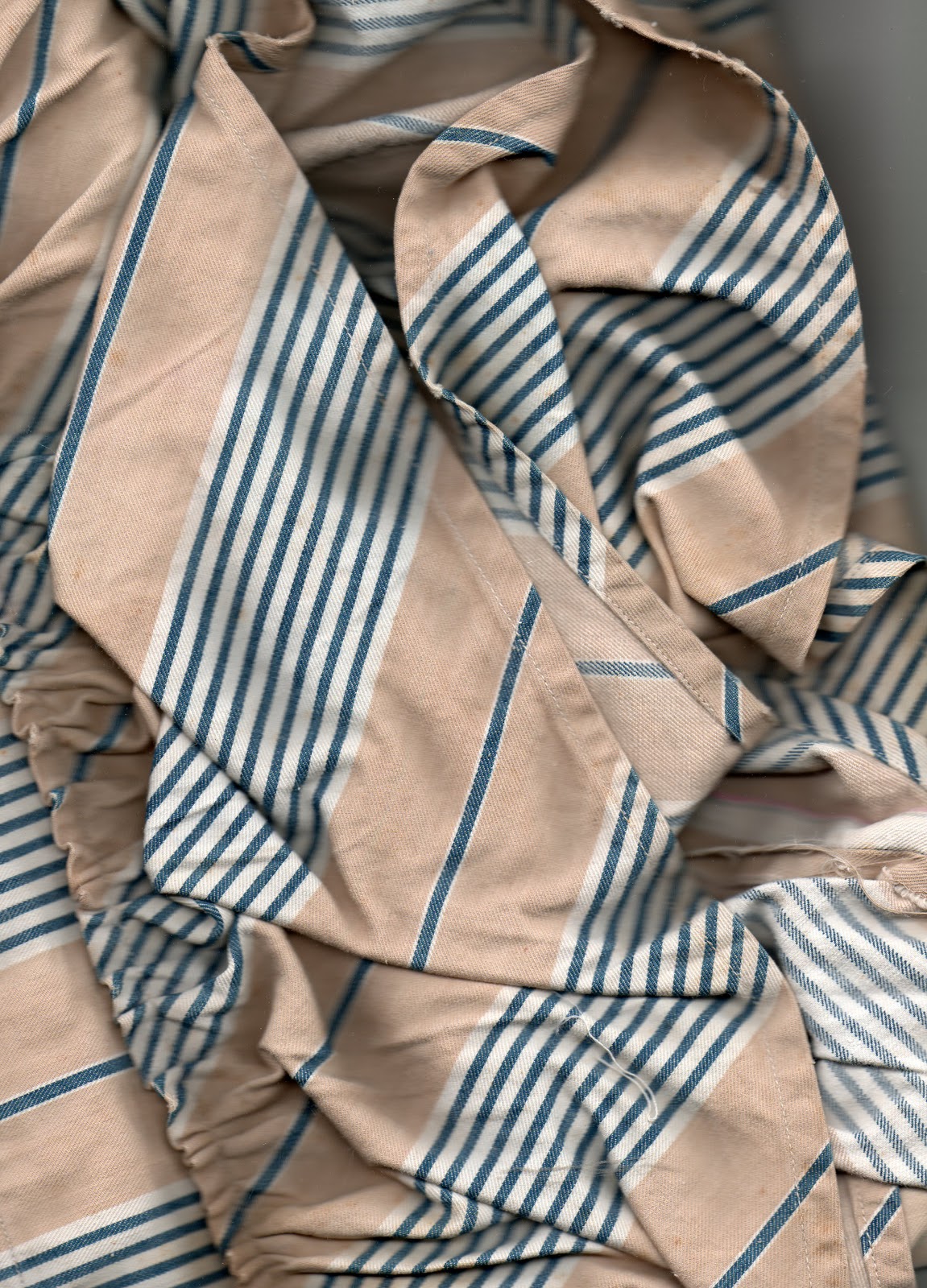
   This scan shows a very old form of mattress used in France by the peasants, made of ticking and once filled with feathers, hay, straw or maize husks.   There is a long slit half way down the centre and this was used to hand-fill the inside with whatever material was available and cheap to replace.   With minimal hygiene, outside privies, and the usual leaks of children and sick people on them, the fillings were burnt when too bad to use.  The maize husks were ideal as they were curly and flexible and sometimes they were mixed with horsehair for greater comfort and support.  I have had some of the horsehair from the Northeast of France where many cattle and horses were used and reared, and it came in the form of a 'dreadlock' twisted round a stick.  I thought they were part of a wig, but was told by my good friend Bryony Thomasson who knew everything about the old customs of the farmers, that these 'curls' were cut up in short lengths and mixed with the other fillings to give a good bounce to the bedding.  The contents were stirred round every day and plumped up and hung out of the window to clear them of their insect life and then returned to the very rigid slatted wooden beds, two matresses below and one on top of the sleeper and sometimes a small 'edredon' to keep the feet warm!  Pillows and bolsters were made in the same way, with slits and no buttons or ties and I used to see a lot of them in the old brocantes when I first trawled  the South West and was searching for tickings.  The tickings were usually in brown shades with odd red lines, and often in a linen herringbone weave.  If they were filled with feathers, they had to be sewn in with tiny stitches to stop the feathers going everywhere;  the tickings themselves were down-proof and very strong.  The German tickings came in wonderful mixes of colours but the French are fairly sober, or in indigo blue wide stripes or checks    Chicken feathers were the cheapest, but duck feathers were curled and much superior - goose feathers were reserved for bolsters as they were fairly stiff and solid.  It seems that in England we only had black and white fine striped tickings during the 19C. quite classic and smart, but very utilitarian and I think they were made somewhere in Lancashire, perhaps Bolton?   Correct me, please.
Quantity of traditional indigo/white striped mattress ticking - all unused.   SOLD.

Monday, 4 May 2015

GROUPIES & COLLECTORS

Dressing table set


    If, like me, you enjoy collecting small and pretty things,  make a bit of impact in a corner or above a low piece of furniture.  I have always preferred to make a small group which give interest in a room or passageway, rather than repeating the same object many times!  Having a theme gives you much more chance of finding additions, both cheaper, and  much more interesting to the casual visitor!   I started collecting 'same things' for my 3 daughters;  china shoes for the second, mini tea sets (2 or 3 inches across their little trays) for the eldest, really as a means of getting into antique shops and spying out stuff for my own collections.  It worked well, and god parents and aunties knew what to give them as little presents, but now there are few shops that deal in such trifles and the prices, if they do have any in stock, are not at all triffling! so the fun has gone out of it.  Last month, on Ebay,  I did buy a pretty dressing table set, Victorian with blue/green foliage and pink flowers on the candlesticks, little lidded pots and a ring tree for £10, which is great,  and there are more at that sort of price, but there is a limit to my number of dressing tables to hold them and my time for dusting them.  Kitchen dressers are an obvious display area and personally I love a good mix of pottery, jugs, mugs, bowls and tea pots, either all rather bright and rustic, or china in soft pretty shapes and colours in a more elegant layout.  I like to have a shelf of pretty things below a window on the stairs, or high above the kitchen stove or the sink which are not usually  things of beauty - and they cheer me up when I have chores to do!
  A collection of different patterned French enamelware can be good fun if you have a good space to fill;   if it is chipped and faulty, it will be cheap, but do not be tempted to use it for cooking, it can be very dangerous and poison you!   French  kitchen and table fine wirework arranged in a group can look so attractive against whitewashed plaster walls and you can still find good examples.  Baskets hung from the ceiling always look good;  butter and cheese making tools are other possible fields for collecting.  Looking round the 'byegones' and tool stalls at French fairs can start you off and do allow time for the seller to tell you their history and use.  Ebay can be a useful source, but is not such fun as digging and delving at a big general antiques fair and actually handling the goods before you buy.
Breakfast time!  Egg baskets and part breakfast  service. French 'marriage' china below
with white rabbit jelly mould

A good collection of baskets. Laduz Museum, France
   
French wirework kitchen tools

Vintage Dorset Buttons for Babies' clothing
                             

Saturday, 2 May 2015

FASHION,FABRIC,FUSION

     Sat. Sun. 6th, 7th.  June, 2015. This is part of a new series of small fairs organised in my home town of   Bradford on Avon in the interesting old vaults (ground level) in the centre of the town!   free entry, parking nearby  and a good medley of coffee shops and eateries within a few steps.  This is my first attendance on the first day, Saturday, and I will be clearing the very last of my old stock of antique fabrics at rock-bottom  prices, to include sewing gadgets and tools, spools of thread, tapestry needles etc., etc. as well as a pretty Paisley shawl, unused hemp grain sacks from the Ukraine (for upholstery) and a rare large panel of Toile de Jouy for a bed hanging plus my usual array of interesting oddments!   I have  been trading for over 30 years so this is my final fling!
  Our ancient market town is full of lovely old Bath stone buildings, the famous Saxon church and splendid Tithe Barn, and the river Avon flows gently through the town under an ancient bridge, with a smart new hotel and spacious terrace and pub, Timbrells Yard, on the river bank, only minutes away.  We were amongst the top 8 towns chosen to live in, in a recent newspaper survey, and I would agree, so do come and spend the day in a bit of lovely old England!    FREE ENTRY.

Monday, 27 April 2015

ODDS AND ENDS

 A cushion cover made from Basque kitchen tea towel, a ticking window seat and a bit of Toile curtain

   If you  read my blogs, you will know that I am passionate about recycling old cloth into other uses so that they live a happy and useful life till they are rags!   I never throw any remnants away and somehow manage to find other bits that go with them and I will illustrate a few of my ideas in case they amuse or inspire you :


seat cushion (2) and cover (3)
 3 different tickings
 Linen and ticking back cushion (1)           
a 'flower power' pin cushion


Cushion made with old linen sheet and two strips of ticking, 
 pin cushion, quilted scraps, pins with sequins threaded through.
coat hangers, first lined with curtain bump cloth 

Tickings and ginghams -cut-offs from cushions!


ALL AT SEA

   I came across this review of a new book THREADS by Julia Blackburn, Jonathan Cape, that made me want to get it out of my library for the amazing story and illustrations done by a sea-faring mental patient who found sewing so therapeutic.  I myself have always found using my hands and creating something give me peace and happiness in a way that trying to use my brain does not always do!  And there is always the added benefit if it is successful, that you have made something physical which you can keep or pass on for the pleasure of someone else.
                            John Craske was a restless and unhappy man who spent much time in mental hospitals. It was his wife Laura, a sturdy Norfolk woman, who suggested he try to soothe himself by making a picture and sewing - she took some calico which she was saving for the Christmas pudding, tacked it on a frame, found some wools and showed John how to fill in the outline of a boat.  Craske died while  working on a 9ft piece depicting the evacuation of Dunkirk.

Thursday, 23 April 2015

A GOOD DAY OUT!

 Here is my suggestion for a really good day out!   This lovely old house and garden are the setting for one of our most prestigious open days!  Talent for Textiles are arranging a large quality textile fair in a marquee at Deans Court and judging by the reports of the last year's event, this will be a delightful and interesting occasion:  lovely architecture, excellent refreshments, big choice of  well selected textiles of every kind, and a beautiful garden to wander around. Entry £5.
For more info. maps, etc.,Email   textile@lindaclift.co.uk.