Sad News
This is written by Zani, Elizabeth's daughter.
After several months of ill health, Elizabeth passed away peacefully on the 18th August 2016. She loved her blog and her textiles. Thank you all so much for your friendship and support.
Wednesday, 31 August 2016

Sunday, 18 October 2015
THE BEE LINE
My bee-keeping outfit of a white space-suit type over-all with fencing hood and some long white kid gloves have arrived from Pakistan and very smart and pristine they are. It is time to meet the bees who were installed by a kind friend in my new hive where they are to work and supply me and family with honey and do a little public work, pollinating the local fruit and vegetable crops. Dressing up can be fun, but I am unsure how to start making myself bee-proof and know I might forget a vital item and leave a hole for the bees to invade my space.
So first, should I put on the gear? or, should I get the tool box ready and light that tricky smoker? then dress up! I decide to get everything ready on the front door step which is convenient for both jobs - My housemaid's plastic tray-box with handle holds the hive tool, a queen cage, two canvas roller covers and a plastic bag for collecting brace comb. I can nip inside the house, out of the wind, to light the smoker and use the steps to pull on the suit and wellies. Smoker stinks of previous fires and I have not curled up enough corrugated paper to get it all alight - smoke pours out into the hall and into my hair while I struggle with broken matches and shaky hands. Once alight and sending out plumes on the terrace, I concentrate on pulling the over-large suit onto my legs - suit seems to be made for a giant although I played safe and ordered a medium size for suit and gloves - I thought Pakistan bee-keepers might be rather smaller than Brits? Half- way through fixing the fencing type head-gear on, I realise I have forgetten my glasses - how on earth will I see the eggs and the queen without them? So off with the top part, on with the loop of glasses and I survey the many- fangled zips - which one to close first? One round the neck with two rings to pull seems to be rather important but no! the up and down the body one gets priority and there is a neat little extra zip down the bottom which I presume is for gentlemen caught short, and somewhat useless for ladies. There are several small loops to be sorted out - one for each little finger on the cuffs to stop the sleeve rolling up - quite neat! another loop to hang up the quite bulky suit and two more on the long gloves - are they to fasten on my ears?? now I remember I put them on myself so I could hang waxy bee stained gauntlets up with the suit on the bee wardrobe hook - how many bees have I got in my bonnet??The neck zip is very neat and has a velcro patch to cover any possible hiding hole for bees at its closure - they've really thought this security thing through - but then a chilling thought comes to me - how about if the zips get stuck and I am caught inside my suit for days and days with only the bees laughing their heads off while I, unable to eat or drink with the face mask secured, stomp off in my wellies down the lane looking like a spacewoman and frightening all the natives away ?
By now, my smoker is exhausted and no smoke to be seen - oh dear! do I have to go through that lighting business again and how can I strike matches with big white glove fingers that drop everything? A few quick squeezes and suddenly I am choking with a lung-full of acrid smoke, enough to quell a thousand bees -.
As I approach the hives, I remind myself to be calm and steady, to introduce myself with a very gentle puff of smoke at the entrance and maybe another after I have lifted the lid and removed the crown board, and prepare to meet my lovely bees and to make friends with them, in return for their gifts of wax and honey. They seem calm enough and I promise to return when I, too, have calmed down and look after them for future prosperity, and the dressing up becomes a mere formality before coping with the beehive as a regular exercise and pleasure.
So first, should I put on the gear? or, should I get the tool box ready and light that tricky smoker? then dress up! I decide to get everything ready on the front door step which is convenient for both jobs - My housemaid's plastic tray-box with handle holds the hive tool, a queen cage, two canvas roller covers and a plastic bag for collecting brace comb. I can nip inside the house, out of the wind, to light the smoker and use the steps to pull on the suit and wellies. Smoker stinks of previous fires and I have not curled up enough corrugated paper to get it all alight - smoke pours out into the hall and into my hair while I struggle with broken matches and shaky hands. Once alight and sending out plumes on the terrace, I concentrate on pulling the over-large suit onto my legs - suit seems to be made for a giant although I played safe and ordered a medium size for suit and gloves - I thought Pakistan bee-keepers might be rather smaller than Brits? Half- way through fixing the fencing type head-gear on, I realise I have forgetten my glasses - how on earth will I see the eggs and the queen without them? So off with the top part, on with the loop of glasses and I survey the many- fangled zips - which one to close first? One round the neck with two rings to pull seems to be rather important but no! the up and down the body one gets priority and there is a neat little extra zip down the bottom which I presume is for gentlemen caught short, and somewhat useless for ladies. There are several small loops to be sorted out - one for each little finger on the cuffs to stop the sleeve rolling up - quite neat! another loop to hang up the quite bulky suit and two more on the long gloves - are they to fasten on my ears?? now I remember I put them on myself so I could hang waxy bee stained gauntlets up with the suit on the bee wardrobe hook - how many bees have I got in my bonnet??The neck zip is very neat and has a velcro patch to cover any possible hiding hole for bees at its closure - they've really thought this security thing through - but then a chilling thought comes to me - how about if the zips get stuck and I am caught inside my suit for days and days with only the bees laughing their heads off while I, unable to eat or drink with the face mask secured, stomp off in my wellies down the lane looking like a spacewoman and frightening all the natives away ?
By now, my smoker is exhausted and no smoke to be seen - oh dear! do I have to go through that lighting business again and how can I strike matches with big white glove fingers that drop everything? A few quick squeezes and suddenly I am choking with a lung-full of acrid smoke, enough to quell a thousand bees -.
As I approach the hives, I remind myself to be calm and steady, to introduce myself with a very gentle puff of smoke at the entrance and maybe another after I have lifted the lid and removed the crown board, and prepare to meet my lovely bees and to make friends with them, in return for their gifts of wax and honey. They seem calm enough and I promise to return when I, too, have calmed down and look after them for future prosperity, and the dressing up becomes a mere formality before coping with the beehive as a regular exercise and pleasure.
Thursday, 10 September 2015
LADIES AMUSEMENTS 2
 |
| dried and pressed sea-weed picture from the Channel Islands A FEW SAMPLES FROM MY COLLECTION OF LADIES AMUSEMENTS |
waste of time, but I do love my bees!
DRIED FERN, DRIED FLOWER and SEA WEED PICTURES, SCISSOR-WORK, CUT-OUT PICTURES( papier coupe ), PAPER SCULPTURE of FLOWERS, a la Mrs.Delaney, SILHOUETTES,PIN PRICK WORK, often religious figures, FELT PICTURES OF ANIMALS, PLANTS, BASKETS OF STRAWBERRIES, especially sought after and so charming! SILHOUETTES, human HAIR mormentoes made up in braids and plaits , Shell covered boxes and ornaments, The materials and skills involved shows how Victorian ladies used their hands to create pictures of delight.
The following Blogs will show just some of the samples of Ladies amusements, (Regency and Victorian craft work on pictures), which I have bought, sold and collected in a very informal way for my own amusement, and also to decorate the bare walls of each house I have renovated. Some are quite rare, others can still be found occasionally at the big general fairs, un-recognised by the sellers and very often in very poor frames which can easily be replaced and make a great difference to the charm of these rather delicate subjects. Birds and flowers predominate of course.
Dried flowers pressed between sheets of blotting paper are fairly common in Victorian scrap books, but often very faded and incomplete without foliage. There are some exceptional groups of ferns which are often quite large and very stylish and decorative, and properly framed, these are very attractive in groups on large empty walls! Sea-weed, see above picture, dried and placed in a little woven basket, in semi-profile on a parchment backing, can be very sweet and often have a little poem below " Call us not weeds, but flowers of the sea are we " and are best seen in little boxed frames, well arranged and not flattened out. Many natural history subjects, like flowers, insects, butterflies, birds' eggs, etc., can be much cheaper to buy in later print form rather than in the original natural history volumes which are now rare to find as more and more are broken up to get the max. return on scarce designs - ' pity too' as the Welsh would say! More about these sort of pictures will follow with a few examples that I have owned or seen on my travels. There is not a great deal of literature about Ladies Amusements as they were considered amateur and trivial and there was no proper market place for them as they were made at home and kept in the family, together with samplers and other hand-made decorations. They were just 'family things'.
Tuesday, 14 July 2015
BLOG ON, BLOG OFF
I am sorry for the intermittent nature of my Blogs just now - few and far between, but maybe that is a good thing! The fact is that I am off on 2 new project (more news later) and have had little time to do things like gathering the pictures and references for any writing bits and have had a really busy programme of work to complete here in my old house - entirely for my own benefit, giving my whole house a complete shake-up, the garden a re-make, my clothes a re-sort out, and as my 89th birthday and an Italian holiday both in Sept. entice me on to complete everything in time, I FIND MY DAYS ARE VERY FULL AND THE MIDNIGHT WRITING PROGRAMME IS JUST TOO LATE; please bear with me and I will be back regularly quite soon and on into the autumn and winter maybe and then it may be time to bid you, all my friends and readers, goodbye..
Sunday, 28 June 2015
BAGS I ?
 |
| A collection of my bags, all made from second-hand scraps of old ticking, clothing or furnishing materials with old linen sheet linings, all hanging on an old French pot rack. |
 |
| This was originally a very smart linen horse blanket from a French stable! You can just see my initials on the coarse linen lining top right., found on a damaged bed sheet. It is totally washable, very strong and I prefer it to an Asda or Tesco bag! |
cross-stitch initials on them for show - I do the same and of course am always looking for my own initials, E and B which are fairly common and over the years I have collected all the hand towels, napkins, tablecloths, hankies, etc. that I need but do not try and pretend I have a French grandmother!

Monday, 22 June 2015
THOUGHTS FROM MY BATH CHAIR no 2
Getting my business going! |When I came to the West Country and decided to sell second-hand curtains from France, especially large ones from the chateaux which suited my own house and many other Georgian houses in the Bath area, I had to get myself known and so signed up to the first Bath Decorative Fair held in the Pavilion in Bath. It was the greatest fun and I loved every one of the 12 following I attended. Hundreds came by and often commented on my rather light-hearted French Brocante look and I made many firm friends who shared my taste for the pretty, unusual and inexpensive adornments. The mood changed from the rather heavy over- frilled, over- fringed, rather shabby, Victorian (known to me as the frilly knickers look) to something rather simpler and in better taste and adapted to modern living, so I was able to combine my linens and fine cotton prints with kitchenalia and country living decorations, as well as hanging on to a few tassels and fringes.
I tried going to the big fairs like Shepton Mallet, which I found very cramped for selling space and very tiring, and frankly, most of the passing crowds were not interested in decorating. So when the chance to attend a really up-market decorative fair at Eastnor Castle, Ledbury, came up, I signed on with a new friend with huge talent, Polly Lyster. who was deep in indigo-dyeing mood!
 We decided to wow everyone with an all blue and white stand, no other colours allowed. Polly provided her blue sheets as a background and then hung tie-dyed chiffon and silk shawls and scarves, with a good selection of the dazzling ikat cushions she has always excelled at. I provided lots of chunky linen and hemp sheets and drapes in cream and white shades and there was a good assortment of French cream farmers' shirts, sturdy blue work aprons and striped tea towels.We were delighted to find several other beginner

 designers were there to show their skills for the first time to the public - wacky hats, and beautiful linen hand-embroidered from the Volga Linen Co. We were in a prime position opposite the main entrance in the marquee (early booking always helps for a good spot) - and one of the first visitors was Hester Paige, features editor of Country Living, and she made a bee-line towards us. What followed is now history but it was very exciting.! Polly and her family and home were featured in the magazine which lead to many good sales and contacts, she was invited to show at their big Christmas Fair in London and that was only the beginning -- her name and business have prospered ever since, always backed by her talent and extremely hard work. It's so good to have a lucky break at the beginning of your career. And I would say, you should always be ready and willing to chance a new opportunity - don't let it go by as offers can be very few and far between - and also be sure to look after generous friends and contacts and show them some gratitude! Volga Linen has become a very well-known brand with gorgeous catalogues, an outlet in London and a warehouse in Suffolk - well done Theresa Tollemache! who launched it all because she had a Russian grandmother and was inspired by her embroidered linen from the banks of the river Volga. Inspiration and industry seem to be the successful combination for starting a new business!
I tried going to the big fairs like Shepton Mallet, which I found very cramped for selling space and very tiring, and frankly, most of the passing crowds were not interested in decorating. So when the chance to attend a really up-market decorative fair at Eastnor Castle, Ledbury, came up, I signed on with a new friend with huge talent, Polly Lyster. who was deep in indigo-dyeing mood!
designers were there to show their skills for the first time to the public - wacky hats, and beautiful linen hand-embroidered from the Volga Linen Co. We were in a prime position opposite the main entrance in the marquee (early booking always helps for a good spot) - and one of the first visitors was Hester Paige, features editor of Country Living, and she made a bee-line towards us. What followed is now history but it was very exciting.! Polly and her family and home were featured in the magazine which lead to many good sales and contacts, she was invited to show at their big Christmas Fair in London and that was only the beginning -- her name and business have prospered ever since, always backed by her talent and extremely hard work. It's so good to have a lucky break at the beginning of your career. And I would say, you should always be ready and willing to chance a new opportunity - don't let it go by as offers can be very few and far between - and also be sure to look after generous friends and contacts and show them some gratitude! Volga Linen has become a very well-known brand with gorgeous catalogues, an outlet in London and a warehouse in Suffolk - well done Theresa Tollemache! who launched it all because she had a Russian grandmother and was inspired by her embroidered linen from the banks of the river Volga. Inspiration and industry seem to be the successful combination for starting a new business!Monday, 15 June 2015
EVEN LESS TIME!


just measure twice and cut once!

Thursday, 11 June 2015
When mending is a work of art
 | ||||||||||||||
| A tote bag made from scraps of early 19thC .hand-woven linen feather bed covers. |
When I first starting dealing in linen and bought large quantities as 'job lots' for very few francs and sorted through the piles when I got home from France, I often found the most beautiful small darns on the best sheets and pillow cases, which I admired. They copied the lines of the threads and were done in the finest little stitches so they blended perfectly. Others had the cleverest little circular darns which were done on the basis of a wheel to fill the round hole and the spokes were sewn first and then further threads were woven till all was filled in.. I kept these, thinking that young girls had been taught to do these intricate repairs by their thrifty mothers or the 'bonnes soeurs' in the convents. I put them on one side and was then so pleased to meet a textile student who was taking darns and repairs as her thesis subject and she was delighted to add my examples to her collection, and even she was amazed by the accuracy and skill of the French repairs! She obviously got most of her models from old samplers but had not yet looked at French linen cupboards!
I have always repaired and patched all my own linen sheets, using the faulty ones up, from my buying expeditions, sometimes saving the elaborate borders, if in good condition, and adding them to plainer ones! A lot of French sheets, though often very narrow, are extra long, to fold over the huge bolsters that are common , so there is spare material.
Every year I have a visit from a delightful Japanese craft worker - she travels round England with the lightest of luggage, hitch-hiking when possible and staying with old friends who welcome her. She loves indigo-dyed cottons and linens from France and I have now learned to save every scrap for her when I make my bags and aprons, all from 18th,19thC indigo printed and dyed bedding remnants. I am quite economical but she is a fanatic!
She falls on them with the greatest delight and takes them back to a smart shop in Japan where they love her hand-sewn re-creations. The clever thing she does is to repair holes and damaged areas with obvious patches and masses of hand stitching; every one is different and it's really very amusing to think that something so original can be made out of discarded samples. She came to see me this year and cleared my last few scraps with the usual cries of delight, and then presented me shyly with this bag which is really a miracle of patches and decoration. There are squares of darning here and there, many additional running stitch lines in criss-cross patterns, a good pocket and extra bottom lining inside the latest bag shape from Paris cat-walks, and is a total delight - so many hours of meticulous hand work and someone who is totally inspired by the materials she has in her hands. Such a lovely girl! and her bag - a lovely gift I value more than one from Mulberry, our local up-market bag maker!
Monday, 1 June 2015
Bobo (the new bohemian bourgeois look)
 |
| Barge toleware decoration was often called 'castles and roses' as these were a feature. |
Gypsies and tinkers always fascinated me and I loved gypsy music from Hungary with its wild czardas and the violins singing. They used to go round the lanes in South Wales in little carts pulled by small sturdy horses and they had straw in the cart, with Welsh 'Gaudy' china (often called Cottage Swansea whence it came) on board. This was delightful jolly china decorated sponge-ware, with big blue roses and pinkish rhododendron type flowers, big blobs, often with highlights of silver lustre, in a circle on cups and plates and other useful tableware. The women and children sat on the cart sides and were a dirty and cheerful lot - my mother bought enough to decorate a cottage Welsh Dresser for our "Cardi" holiday cottage and 20 years later, at the beginning of the war, sold it all to collectors who were very keen on it, quite rare and expensive now! Other examples are shown on Ebay of course. And tinkers! I have fond memories of the delightful old knife grinder who came round once a year to my house in Freshford, near Bath, with a grindstone on a sort of bicycle frame.. He wore a flat cap at a jaunty angle and there was always a flower decorating it; I gave him a bun and hot tea and he told me a little about his travels (from Ireland)- those sort of travellers have almost gone now, they have been chased away by traffic and suspicious police, but they were quite often very amusing with a quick turn of phrase and simple charm. and my knives and scissors have never been as sharp since he disappeared.
The gypsies used to come round with baskets of dolly pegs and they were wonderful for hanging washed blankets - plastic are not nearly sturdy enough, and people used to buy them from me to make little dolly figures. They also made lovely little square hanging baskets from short thick twigs interlaced, and put primroses also 'taken' from the local woods in a bed of moss inside - and I used to buy some to re-sell to my customers at my flower shop! Naughty!
 |
| Welsh Gaudy pottery |
Tuesday, 26 May 2015
EBAY! TAKE IT EASY!
 |
| A period dressing chest (Edwardian, repainted) |
 |
| Simple Edwardian wardrobe, re-painted. |
Sunday, 17 May 2015
BED AND BOARD

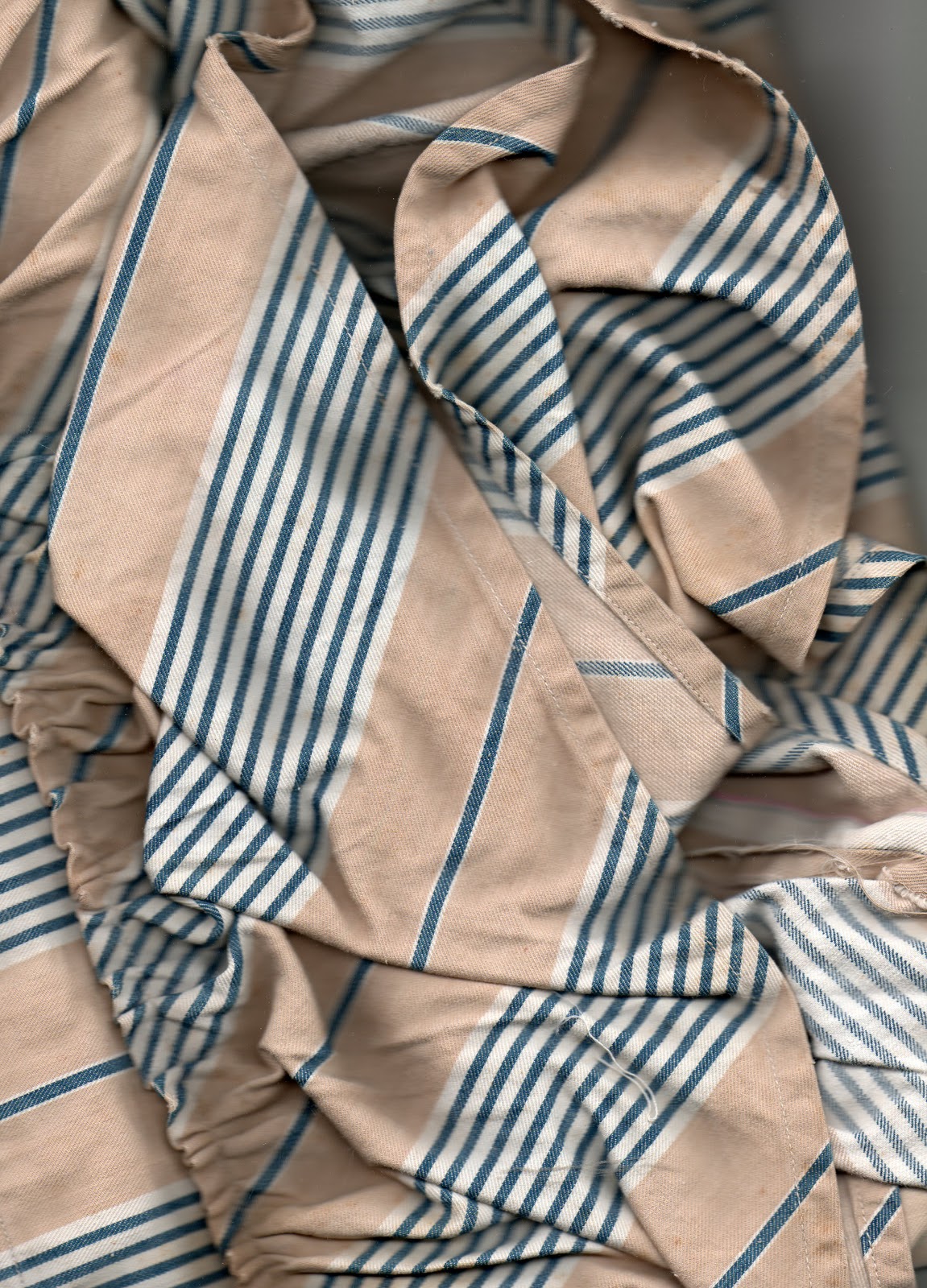 |
| attractive frilled door curtain, as new sturdy French ticking |
 |
| Quantity of traditional indigo/white striped mattress ticking - all unused. SOLD. |
Monday, 4 May 2015
GROUPIES & COLLECTORS
 |
| Dressing table set |
If, like me, you enjoy collecting small and pretty things, make a bit of impact in a corner or above a low piece of furniture. I have always preferred to make a small group which give interest in a room or passageway, rather than repeating the same object many times! Having a theme gives you much more chance of finding additions, both cheaper, and much more interesting to the casual visitor! I started collecting 'same things' for my 3 daughters; china shoes for the second, mini tea sets (2 or 3 inches across their little trays) for the eldest, really as a means of getting into antique shops and spying out stuff for my own collections. It worked well, and god parents and aunties knew what to give them as little presents, but now there are few shops that deal in such trifles and the prices, if they do have any in stock, are not at all triffling! so the fun has gone out of it. Last month, on Ebay, I did buy a pretty dressing table set, Victorian with blue/green foliage and pink flowers on the candlesticks, little lidded pots and a ring tree for £10, which is great, and there are more at that sort of price, but there is a limit to my number of dressing tables to hold them and my time for dusting them. Kitchen dressers are an obvious display area and personally I love a good mix of pottery, jugs, mugs, bowls and tea pots, either all rather bright and rustic, or china in soft pretty shapes and colours in a more elegant layout. I like to have a shelf of pretty things below a window on the stairs, or high above the kitchen stove or the sink which are not usually things of beauty - and they cheer me up when I have chores to do!
 |
| Breakfast time! Egg baskets and part breakfast service. French 'marriage' china below with white rabbit jelly mould |
 |
| A good collection of baskets. Laduz Museum, France |
 |
| French wirework kitchen tools |
 |
| Vintage Dorset Buttons for Babies' clothing |
Saturday, 2 May 2015
FASHION,FABRIC,FUSION

Our ancient market town is full of lovely old Bath stone buildings, the famous Saxon church and splendid Tithe Barn, and the river Avon flows gently through the town under an ancient bridge, with a smart new hotel and spacious terrace and pub, Timbrells Yard, on the river bank, only minutes away. We were amongst the top 8 towns chosen to live in, in a recent newspaper survey, and I would agree, so do come and spend the day in a bit of lovely old England! FREE ENTRY.
Monday, 27 April 2015
ODDS AND ENDS
 |
| A cushion cover made from Basque kitchen tea towel, a ticking window seat and a bit of Toile curtain |
If you read my blogs, you will know that I am passionate about recycling old cloth into other uses so that they live a happy and useful life till they are rags! I never throw any remnants away and somehow manage to find other bits that go with them and I will illustrate a few of my ideas in case they amuse or inspire you :
 |
| seat cushion (2) and cover (3) |
Linen and ticking back cushion (1)
 |
| a 'flower power' pin cushion |
Cushion made with old linen sheet and two strips of ticking,
pin cushion, quilted scraps, pins with sequins threaded through.
coat hangers, first lined with curtain bump cloth
 |
| Tickings and ginghams -cut-offs from cushions! |
ALL AT SEA
I came across this review of a new book THREADS by Julia Blackburn, Jonathan Cape, that made me want to get it out of my library for the amazing story and illustrations done by a sea-faring mental patient who found sewing so therapeutic. I myself have always found using my hands and creating something give me peace and happiness in a way that trying to use my brain does not always do! And there is always the added benefit if it is successful, that you have made something physical which you can keep or pass on for the pleasure of someone else.
 John Craske was a restless and unhappy man who spent much time in mental hospitals. It was his wife Laura, a sturdy Norfolk woman, who suggested he try to soothe himself by making a picture and sewing - she took some calico which she was saving for the Christmas pudding, tacked it on a frame, found some wools and showed John how to fill in the outline of a boat. Craske died while working on a 9ft piece depicting the evacuation of Dunkirk.
Thursday, 23 April 2015
A GOOD DAY OUT!
Here is my suggestion for a really good day out! This lovely old house and garden are the setting for one of our most prestigious open days! Talent for Textiles are arranging a large quality textile fair in a marquee at Deans Court and judging by the reports of the last year's event, this will be a delightful and interesting occasion: lovely architecture, excellent refreshments, big choice of well selected textiles of every kind, and a beautiful garden to wander around. Entry £5.
 |
| For more info. maps, etc.,Email textile@lindaclift.co.uk. |
A VERY FRENCH faux pas
When you start collecting anything, I do think it is a good idea to do a little home-work on the way!
A trip around Ebay on the Internet is a useful start and cross reference, and, when you do find something; most sellers are pretty good at describing their goods, but you should beware of the words antique, period, vintage, as they are not always accurate and some goods are little more than second-hand and should be priced accordingly. Paying by Paypal is a good safety net and sellers who disappoint get their Ebay rating lowered which spoils their reputation!
It's worth going to as many antique fairs as you can and visiting shops that have the sort of things you are interested in - not that there are many antique shops left now or real junk shops, but plenty of charity shops where you have to value things for yourself! Antiques fairs at all levels provide excellent choices, but you need to know your onions a bit before spending large sums with unknown dealers, unless you are going to a vetted fair when you may have to pay top prices The BBC Homes and Antiques Magazine is useful and there is also the Antique Collectors Club which I used a lot in the past. They have a useful For Sale section and lots of descriptions and photos and prices of average antique items.
I learnt my lesson with fakes when I was supplying a very top picture dealer in Knightsbridge with rustic folk art for his studio showroom. He showed his pictures in a beautifully arranged room setting, Regency painted chairs round a French trestle table, a real gas fire and odd small tables and candle stands, and a few valuable primitive pictures of children, animals and rustic scenes on the walls with the odd old shop sign or bit of kitchen ironwork hanging from the ceiling. My mission was to supply some of these byegones and, of course, I took much trouble to be sure they were genuine.
So, one day I bought a red painted pull-along bull from a street market in France, very cheap, from an old peasant! It was quite rough and had a worn-out, very knotted, string to pull. My friend Andreas loved these articulated 1920's toys and sold them at great profit to his New York City dealers for their desks, to play with! When I got this toy back to the hotel, I then noticed that one of the hind legs of the bull had been fixed the wrong way round and I thought it strange and rather unlikely that a countryman would have made such a mistake. So, guess what! I went to another fair next day and to my shock and horror saw another identical faked bull pull-along toy, but this time the legs were o.k., though the pull-along string was frayed and knotted as before. Lesson learnt! from a bit of bulls---!
A trip around Ebay on the Internet is a useful start and cross reference, and, when you do find something; most sellers are pretty good at describing their goods, but you should beware of the words antique, period, vintage, as they are not always accurate and some goods are little more than second-hand and should be priced accordingly. Paying by Paypal is a good safety net and sellers who disappoint get their Ebay rating lowered which spoils their reputation!
It's worth going to as many antique fairs as you can and visiting shops that have the sort of things you are interested in - not that there are many antique shops left now or real junk shops, but plenty of charity shops where you have to value things for yourself! Antiques fairs at all levels provide excellent choices, but you need to know your onions a bit before spending large sums with unknown dealers, unless you are going to a vetted fair when you may have to pay top prices The BBC Homes and Antiques Magazine is useful and there is also the Antique Collectors Club which I used a lot in the past. They have a useful For Sale section and lots of descriptions and photos and prices of average antique items.
I learnt my lesson with fakes when I was supplying a very top picture dealer in Knightsbridge with rustic folk art for his studio showroom. He showed his pictures in a beautifully arranged room setting, Regency painted chairs round a French trestle table, a real gas fire and odd small tables and candle stands, and a few valuable primitive pictures of children, animals and rustic scenes on the walls with the odd old shop sign or bit of kitchen ironwork hanging from the ceiling. My mission was to supply some of these byegones and, of course, I took much trouble to be sure they were genuine.
So, one day I bought a red painted pull-along bull from a street market in France, very cheap, from an old peasant! It was quite rough and had a worn-out, very knotted, string to pull. My friend Andreas loved these articulated 1920's toys and sold them at great profit to his New York City dealers for their desks, to play with! When I got this toy back to the hotel, I then noticed that one of the hind legs of the bull had been fixed the wrong way round and I thought it strange and rather unlikely that a countryman would have made such a mistake. So, guess what! I went to another fair next day and to my shock and horror saw another identical faked bull pull-along toy, but this time the legs were o.k., though the pull-along string was frayed and knotted as before. Lesson learnt! from a bit of bulls---!
 |
| This is rather similar to my 'fake' red bull, without its string! |
Saturday, 18 April 2015
ON THE WING - AND A PRAYER
THE CLOTHES MOTHS ARE BACK WITH US earlier than ever after the mild winter and they are out looking for cosy, warm, woolly nesting places. Yesterday, I found 5 just crawling out from under a blanket chest, all ready to mate and lay their tiny eggs all over the house as they did last year when the larvae nibbled small holes in quite a few places. Go to the ironmongers/chemists now for the moth traps that work well for telling you they are seeking their mates and on the offensive! My ironmonger has already almost run out of supplies OF SPRAYS AND CAMPHOR BALLS, and said he had big problems last year getting the right sprays etc after that pandemic! I have found that the moths especially love anything with animal hair in the weave - cashmere, angora, alpacca and Persian rugs, as well as sheep's wool. I just pray I have everything covered and safe. My neighbour has already lost a favourite tapestry cushion to the little pests.
Wednesday, 15 April 2015
THE SATURDAY BOOK

They had great knowledge of many British folk art items and were amongst the first to elevate them to the 'collection' status - they immersed their small homes in this rich mixture and their enthusiasm and erudition on all subjects to do with buildings and their contents was very endearing to me. They were friends of my Uncle Clough, architect, and we went together to visit Olive somewhere near Dunmow for strong black coffee with all the grounds in the bottom of the cup - my uncle told me I should make coffee like that in future, as he was staying with me, aged 90, while his wife Amabel, went off to India to learn more about Hare Krishna Religion, as a granddaughter had become involved! Clough Williams-Ellis, creator of the hotel village Portmerion, was a very memorable character and much loved - we went to Bishops Stortford College to see about some of his urns that had been removed from a high gabled entrance block building, the first modern building to be given listed status, and all because of H. and Safety concerns, which annoyed him greatly. However they were later found in a local garden and re-erected so honour was saved and he went back to Wales very happy.
The book I quoted was called Collector's Items from the Saturday Book, by Olive Cook and Edwin Smith 1955 Hutchinson pub. It features several hundred objects, often small and primitive, covering pottery, needlework, carving, furniture, toys, pictures and much else, often taken in their original surroundings, mostly cottages and old shops but also circus, seaside, and often regaling their own mantlepieces. When I look at all these illustrations, I get quite sentimental as they show so many of the things I used to see and buy in my forays into dusty old shops and junk markets, and I have kept a few examples for myself in my little groups for decoration and amusement.
Tuesday, 14 April 2015
SHOW OFF!
Displaying textiles at a Fair is quite a problem - you can't do much with the one 6' trestle table usually supplied and there are no hooks or rails to help on the walls. You can show small piles of similar things on the table but you really have to have hanging space for most larger pieces. So you must resort to collapsible dress rails which are heavy (if strong enough for considerable weights)and take up quite a bit of your valuable floor space. Over the years I have assembled a variety of props which work quite well and I list them for your info. in case you have similar problems. The most useful aid is my Florence Nightingale screen frame which has three rails on each side. These screens were used at Scutari and other hospitals for privacy for the patients and are well made and very strong, I used to see occasional examples at the big Ardingly Fair in Sussex and have always assumed they were surplus army stock considered obsolete and unhygenic for modern hospitals and sold by the then M.O.D. The upright poles are sturdy and the rails equally strong and the ingenious iron hinges are pretty unbreakable. I sometimes set it up on top of, and at the back of, my sales table. Some people find laundry airing racks handy but they are only good for small items. I have never seen a Florence Nightingale screen with any original fabric, but knowing Florence, and how efficient and practical she was in all her efforts to improve the care of the army, I expect it was something very strong and serviceable and unlikely to have been any flimsy and pretty cotton that we associate with bedrooms screens.
A little wire newspaper stand with shelves for folded papers acts as another display aid.
A folding bamboo bookcase, painted blue, makes good shelf space for heavier linen articles and is light to carry and set up.
I have invented my own 'rack' which consists of two 4" X 2" upright posts about 8' long and have two circular holes (diameter of the two poles) drilled through the 4" side one at the top end and another 15" lower down, for two rails. It has no base . Also, at the top there are two small pegs about 3" long, attached with a string just above the holes, one on each side. I then have two round poles (the rails) about 8' long with pair of small holes drilled to be each side of the uprights when the pole is slipped through the large round holes of the uprights, to take the little pegs on strings. The second (lower) pole can then be inserted and I do not bother with pegs there as the top is firm enough. The whole thing is then safely wedged against a wall if possible, behind the display table(s) which are heavy with linen, etc., and I tie the uprights to any available table legs so it cannot fall forward and maim me and my clients! The two uprights and 2 poles fit in my car with the ends sliding down beside the passenger seat and the whole thing enables me to show large tapestries, long curtains and much more. This saves excessive handling, folding and creasing and gives the customers a good view of large pieces, and the scale of any patterns. See enclosed very rough diagram.
This home-made contraption is now for sale as I have only one small final sale to attend - It is £18 (rather less than the cost of the timber and will easily pack into an ordinary car or van. Regret cannot deliver as am too old for long journeys!
Contact 01225 866 136.
This home-made contraption is now for sale as I have only one small final sale to attend - It is £18 (rather less than the cost of the timber and will easily pack into an ordinary car or van. Regret cannot deliver as am too old for long journeys!
Contact 01225 866 136.
Subscribe to:
Posts (Atom)